
Last updated November 15, 2026
 Metal roofing
 Architectural shingles
 Tile roofing
 GAF
 Owens Corning
 Flat & low-slope
Free roof inspection with deck photos before we talk money - GAF and Owens Corning certified installation
Roofing Warning Signs: A Sunrise Manor Homeowner’s Reference Guide
The most expensive roof failures in Sunrise Manor rarely start as visible leaks. They start as granule loss patterns in a downspout, nail pops along a shingle course, or attic temperature problems that most homeowners walk past for years before a drop of water ever enters the living space. That’s the part national checklists miss. A generic guide tells you to look for missing shingles and call someone. It won’t tell you what the color of a ceiling stain means, why this valley’s thermal swings lift shingle edges faster than the coast, or how to read the grit at the bottom of your gutter as a diagnostic tool. This reference covers all of it, from the inside of the home outward.
Quick Answer
The warning signs that matter most on a Sunrise Manor roof are granule loss in gutters and downspouts, nail pops and lifted shingle edges driven by thermal expansion, daylight or moisture stains in the attic, and interior ceiling stains whose shape and color tell you whether a leak is active, historic, or condensation. Small, isolated problems usually point to repair. Widespread shingle aging, multiple leak points, or a compromised deck point to replacement. An inspection tells you which before you spend on the wrong fix.
Styles & brands we work with
- Architectural shingles
- Metal roofing
- Tile roofing
- GAF
- Owens Corning
- Flat & low-slope
Table of Contents
- Reading Granule Loss in Gutters and Downspouts
- What Your Attic Tells You Before the Exterior Shows Damage
- Nail Pops and Lifted Shingles in a Thermal Expansion Climate
- Interior Warning Signs: Reading Ceiling Stains
- Repair vs. Replacement: Warning Signs That Decide It
- Ground-Level Checks You Can Do Safely
- Seasonal Patterns in Sunrise Manor
- What a Real Roof Inspection Covers
Reading Granule Loss in Gutters and Downspouts
Granules aren’t decorative. They’re the top layer of an asphalt shingle that shields the bitumen underneath from sunlight, and in a place where the sun works on a roof nearly every day of the year, that shield matters more than it does almost anywhere else. When you run your hand along a downspout and come away with a palm full of grit, the shingle is shedding its protective surface. Some granule loss is normal on a new roof for the first year or two. Steady loss on a roof that’s several years old is telling you the shingle is aging faster than its covering should.
Where the grit collects matters. Granules that build up in a gutter valley below one specific slope point to a problem on that slope, not the whole roof. Granules spread evenly along every downspout on the house suggest the entire field is aging at the same rate, which is a different conversation. We see both in Sunrise Manor, and the location of the accumulation is usually the first thing we look at during an inspection.
- Pattern on one slope: often a sign of a local defect, a vent leak above it, or a shaded section holding moisture.
- Pattern on every slope: usually age and sun exposure across the whole roof.
- Grit plus bald patches: the shingle surface is worn through, and replacement or a targeted re-cover is worth pricing.
- Fresh grit after a wind event: check the ridge and the edges first for lifted or torn tabs.
Homeowners often treat gutter grit as a maintenance nuisance to sweep out. It’s better read as a diagnostic. If you don’t know how to interpret what you’re seeing, the right move is a standalone roofing Sunrise Manor inspection rather than a guess, because the same symptom can mean two entirely different things depending on where it shows up.
What Your Attic Tells You Before the Exterior Shows Damage
The attic sees the roof before the living room does. Three things consistently show up there ahead of exterior damage, and none of them requires climbing onto the roof to check. The first is daylight. If you can see a bright spot from inside a dark attic, something above is open, whether that’s a flashing gap around a vent, a ridge joint, or a failed pipe boot. The second is insulation compression. When insulation is mashed down or pushed aside around penetrations, it’s usually because moisture and heat have interacted with it, or because someone was up there working and didn’t put it back. The third is staining. Brown streaks on the underside of the roof deck, water rings around a nail shaft, or a dark tide line across the sheathing all tell a story about how and where water has traveled.
Attic moisture problems are common in desert-climate homes because the temperature difference between a sun-baked deck and a cooled living space creates condensation on cold surfaces. That condensation can look almost identical to a leak from below. Tying the interior sign back to the roof surface is what separates a trained read from a guess.
- Wait until the sun is high, then step into the attic with the lights off and look for light coming through.
- Check the insulation around every vent, pipe, and chimney penetration for compression or damp patches.
- Scan the roof deck sheathing for brown or dark streaks, especially along the lower edge of a slope.
- Look at the nails poking through the sheathing. Rusty or wet nail shafts mean moisture is migrating along the fastener.
- Sniff for a musty smell, which points to trapped moisture rather than to shingle age.
If any of those five checks turn up a problem, you’ll want the roof surface reviewed by someone who understands the local thermal patterns. A full written assessment is what we produce during an inspection, and it’s the honest place to start before spending on repair or replacement.
Nail Pops and Lifted Shingles in a Thermal Expansion Climate
Sunrise Manor roofs live through a daily swing that coastal roofs don’t. A roof deck can heat up under full sun and cool off dramatically once that sun drops, and it does it over and over on an almost daily basis. Shingles and the deck they’re nailed to expand and contract at slightly different rates. That repeated movement gradually backs nails out of their holes, which is what a nail pop is. A lifted shingle edge is the same process working on a different part of the shingle. Neither is dramatic when it happens. Both are worth understanding as warning signs because of what they may be signaling underneath.
A single isolated nail pop in a field of otherwise flat shingles is usually a minor repair. A line of them, or several grouped together on one slope, can point to a deck that has weakened under the repeated movement, or to fasteners that were set wrong when the roof was last installed. This is where a material match matters. When we repair a Sunrise Manor roof, one of the advantages of working across GAF, CertainTeed, Owens Corning, IKO, Atlas, Tamko, and Boral is that we can usually match what’s already there, so the fix doesn’t create a visual scar or break out of an existing system’s warranty coverage.
- One nail pop: a localized repair, and the deck under it should be checked for softness.
- Multiple pops along a course: often a sign of movement across the whole slope, worth a broader inspection.
- Lifted edges on sunny-facing slopes: the seal down has likely failed, and that slope is next on the list for wind-driven water.
- Lifted edges plus curling: the shingle is aging past what a spot fix will help.
Lifted and curled shingles also let wind-driven rain get underneath, which is precisely how a small issue becomes an attic stain the following storm season. You can find a deeper breakdown of repair scope on our roof repair page if you want to understand what each fix involves before you call.
Interior Warning Signs: Reading Ceiling Stains
The shape and color of a ceiling stain tells you what kind of problem you’re dealing with, and this is where homeowners most often misread their own house. A fresh, active leak usually shows as a dark ring on the outer edge with a lighter center, because water carries material as it spreads and deposits it at the drying front. That outer ring is the wet boundary. An older, historic stain that isn’t growing is usually uniform in color, brown or tan, with no distinct drying edge. A condensation problem looks different again, often lighter and more evenly spread, sometimes with a slightly soft or damp feel in humid conditions.
Water that has run down a rafter before showing up on the ceiling looks like a streak rather than a spot. A single round spot directly under a penetration usually traces back to that penetration. An irregularly shaped stain with a dark edge means water is still moving. Knowing which pattern you’re looking at tells you whether you have an active problem that needs attention now or a past one that just needs documenting before you sell.
- Look for a dark outer edge. If you see it, treat the leak as active and get it checked before the stain grows.
- Note the shape. A streak means water is traveling along a rafter; a round spot usually sits under a penetration.
- Check whether the stain has changed since you first noticed it. Take a dated photo so you can tell.
- Feel the drywall near the center. A soft spot, a sag, or a sponge-like texture means the moisture has been there a while.
- Note any musty smell or bubbling paint on the ceiling. Both suggest moisture that’s working its way through the drywall from above.
If you’re seeing a growing ring or a soft patch, that’s a call-a-professional moment. Once a ceiling stain is actively spreading, waiting usually widens the interior scope. When the roof is past saving, our roof replacement service is the right read, and an inspection beforehand makes sure the recommendation is honest about which side of that line you’re on.
Repair vs. Replacement: Warning Signs That Decide It
This is the question underneath every other warning sign on this page. Is a spot repair going to solve it, or is the roof past the point where repairs start costing more than they save? The signs cluster, and when several cluster together, replacement is usually the better financial answer. One isolated problem with an otherwise sound roof is almost always a repair.
- Points to a repair: a single leak traceable to one flashing joint or pipe boot, isolated granule loss, one nail pop, one popped shingle, or a stain that traces back to a specific penetration.
- Points to inspection before any decision: multiple nails popping along a course, granule loss concentrated on a single sunny slope, or a ceiling stain whose origin you can’t identify.
- Points toward replacement: shingles that are balding and shedding across every slope, repeated leaks that return in the same area within a short span, a soft or spongy deck under foot, visible sag along the ridge, or an aging roof that no longer matches the material match for a targeted fix.
The honest test has always been whether the repair will still be working in five years. A well-installed patch on a sound roof will. A patch on a roof that’s losing its surface across the whole field often fails again where the next weak spot shows, and each return trip adds to the pile of money spent. We work with GAF, CertainTeed, Owens Corning, IKO, Atlas, Tamko, and Boral, which means the recommendation on a replacement isn’t shaped by a single-manufacturer deal. It’s shaped by which covering fits your roof, your budget, and this climate. That’s the whole point of brand-neutral advice.
If you’d rather not guess, a standalone inspection is the place to start. We tell you what your roof actually needs before pricing a repair or a replacement, and the estimate is free either way.
Ground-Level Checks You Can Do Safely
You don’t need to be on the roof to spot meaningful warning signs, and we’d rather you stayed off it. Ground-level checks catch a lot before you ever need to look up close. Use binoculars from a safe distance, or take photos from the street and zoom in.
- Walk the perimeter and look at the roofline. A sag, a dip, or a wavy line along the ridge is a serious sign worth an inspection.
- Scan each slope for shingles that sit flat against their neighbors. Lifted corners or tabs that look slightly raised are early failures.
- Look for shingle field color that’s noticeably darker or lighter in one area. Uneven fading points to uneven material age.
- Check gutters and downspout outlets. Granule accumulation, loose fasteners, and water staining where water has overflowed all tell you something.
- Look at the fascia and soffit for paint peeling, bubbling, or a soft feel. Those often indicate a top-of-wall moisture issue.
- Look around chimneys, vents, and skylights. Damaged flashing is where most leaks begin, and it’s visible from the ground.
- Check the ground beneath eaves for dark spots or water pooling, which means water is running past the gutter instead of into it.
If a check turns up something unexpected, take a photo with your phone and call. A quick review of a photo is often enough to tell you whether it needs a visit. For anything involving walking the roof or checking flashing at height, leave it to a trained technician. Falls from height are the most serious risk in this trade, and no warning sign is worth taking that on yourself.
Seasonal Patterns in Sunrise Manor
Warning signs often show up in a rhythm tied to the local seasons. The long hot stretch bakes the sun-facing slopes and drives the thermal expansion that pops fasteners and lifts edges. The monsoon storms that follow bring wind and blowing rain, which is when a lifted edge or a failed flashing joint finally lets water in. In the cooler months, the temperature difference between a warm interior and a cold deck produces the condensation that can confuse a leak diagnosis.
In practice, that means the best time to inspect a Sunrise Manor roof is often before the storm season rather than after a leak shows up. A roof that checked out in dry weather can fail on the first real wind-driven rain if a lifted shingle or a backed-out nail went unnoticed. If you’ve seen an attic stain appear right after a storm, treat the timing as a clue: it points to the leak path the storm found. If you’ve seen a stain that predates the storm and hasn’t grown, that’s a different case.
- Spring into summer: the highest stress period for thermal expansion. Check for nail pops and lifted edges.
- Storm season: check for wind-lifted tabs, displaced ridge caps, and any new water staining in the attic after a rain event.
- Cooler months: condensation issues show up. A damp attic smell or a light ceiling stain in this window is often condensation rather than a leak.
- Year-round: gutter granule accumulation is a constant signal, and reading its pattern is what tells you about shingle age.
Once per season is a good cadence for a quick self-review from the ground, with a professional inspection when anything looks off or the roof is several years old.
What a Real Roof Inspection Covers
An inspection isn’t a sales call in disguise when it’s offered as its own service. It’s a documented walkthrough of the roof, the attic, the flashings, and the interior, ending with a plain answer to one question: repair, replace, or leave it alone. What a proper inspection should walk through:
- Exterior surface review for granule loss, lifted edges, curling, and nail pops.
- Flashing check at every penetration: chimney, vents, skylights, and the walls where the roof meets other surfaces.
- Gutter and downspout review for granule accumulation and water flow.
- Attic review for daylight, insulation compression, deck staining, and rusty fasteners.
- Interior check for ceiling stains and their shape, color, and age.
- Deck and structural check from underneath, wherever it’s accessible, for softness and sag.
- A written summary with an honest read on repair vs. replacement and a written, line-itemized estimate if any work is recommended.
We treat Roof Inspection as a standalone service because it should mean something. The point is to know exactly what you’re dealing with before spending a dollar, not to be pushed toward the largest scope on the menu. Our technicians have up to 12 years of experience, and because we install across seven major manufacturers, the material recommendation is based on what fits your roof, not on a single brand’s inventory. You can see how all three of our services fit together, and what’s different about each, on our Sunrise Manor service overview.
Common Mistakes to Avoid
- Treating gutter grit as a maintenance nuisance. What’s shedding depends on where it collects. A slope-by-slope reading is your best early warning, and sweeping it away without noticing the pattern wastes a free signal.
- Waiting for a ceiling stain before looking up. By the time a stain reaches drywall, water has already traveled through the deck. The attic sees it first, so check there on a routine cadence.
- Assuming every stain means an active leak. A uniform brown patch with no growing edge is often a historic stain or condensation, and paying for a repair you didn’t need is its own kind of loss.
- Patching a single spot on a roof that’s aging everywhere. One pop on a sound roof is a repair. One pop on a roof that’s balding across every slope is the first sign of the whole field failing.
- Skimping on the material match. A patch in a mismatched shingle creates a visible scar and can void a warranty. Working across GAF, CertainTeed, Owens Corning, IKO, Atlas, Tamko, and Boral means we can usually match the existing product on the roof.
- Climbing on the roof yourself. Thermal-baked shingles get brittle, and the risk of a fall is real. The ground-level checks catch plenty, so let a trained technician handle the height.
- Treating an inspection as a sales pitch and skipping it. The right inspection answers repair-vs-replacement before a decision gets made, not after. An inspection that exists only to sell a replacement isn’t doing its job.
See the difference
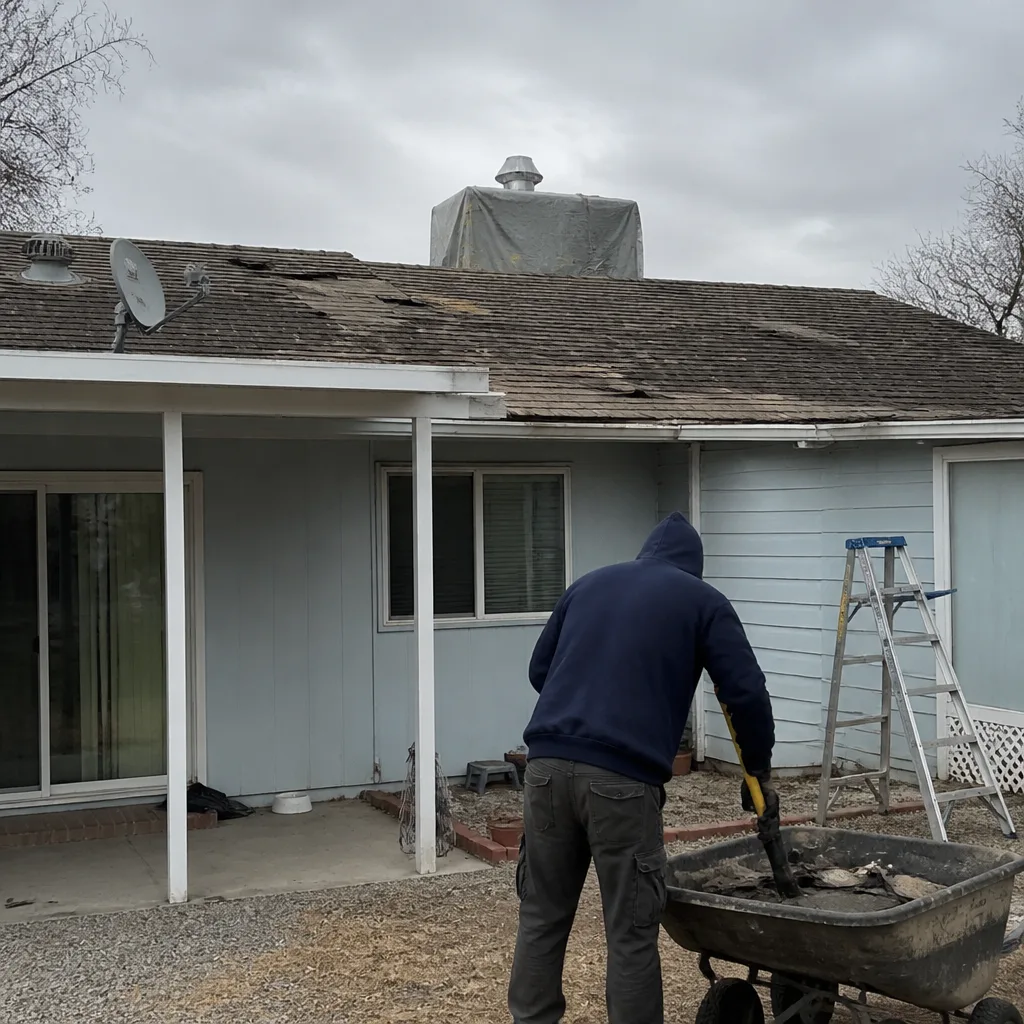 Before
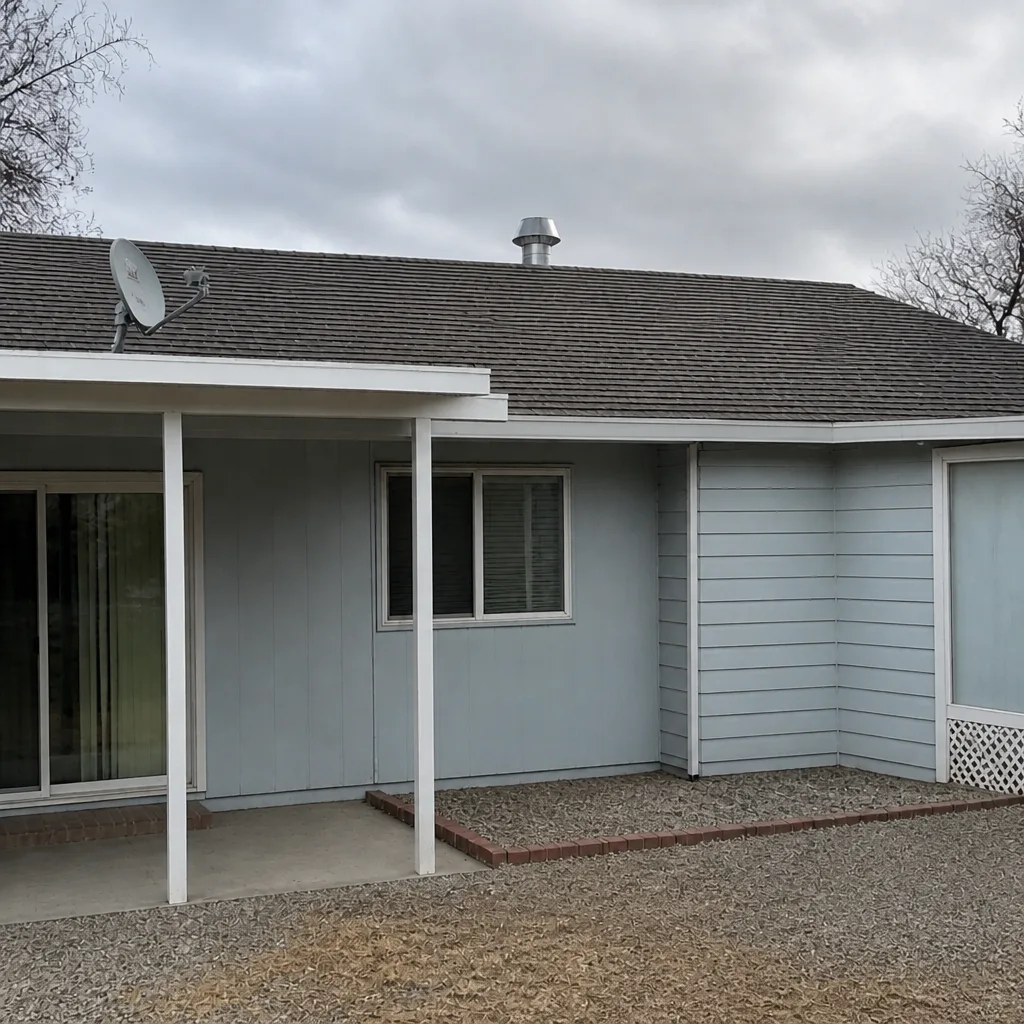 After
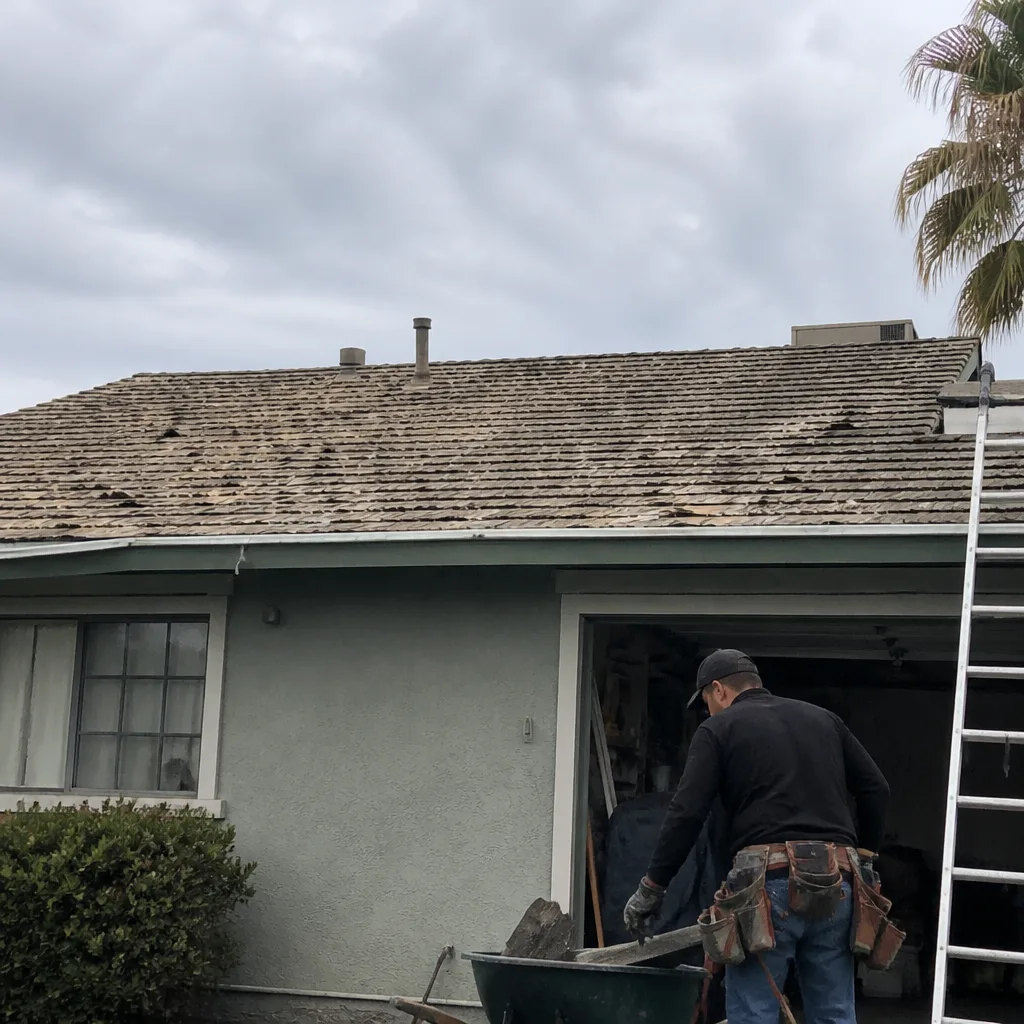 Before
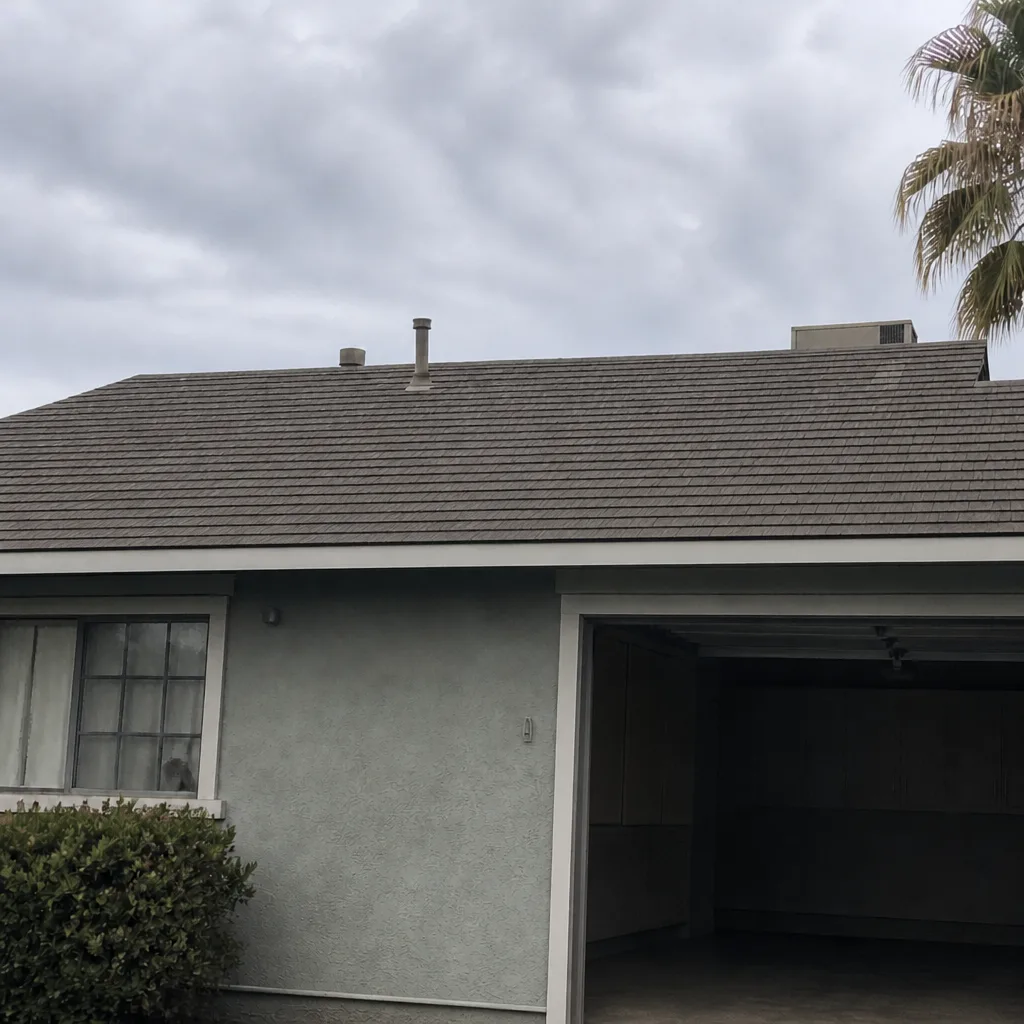 After
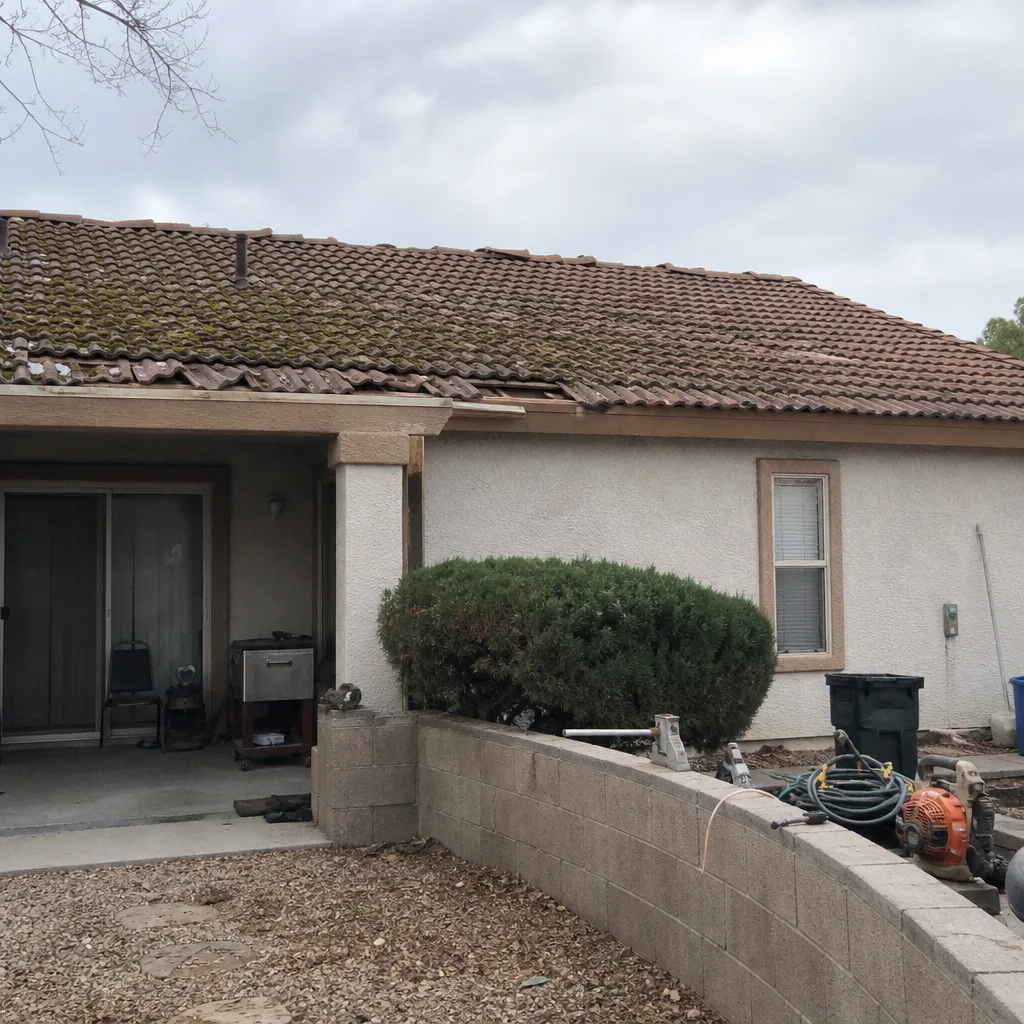 Before
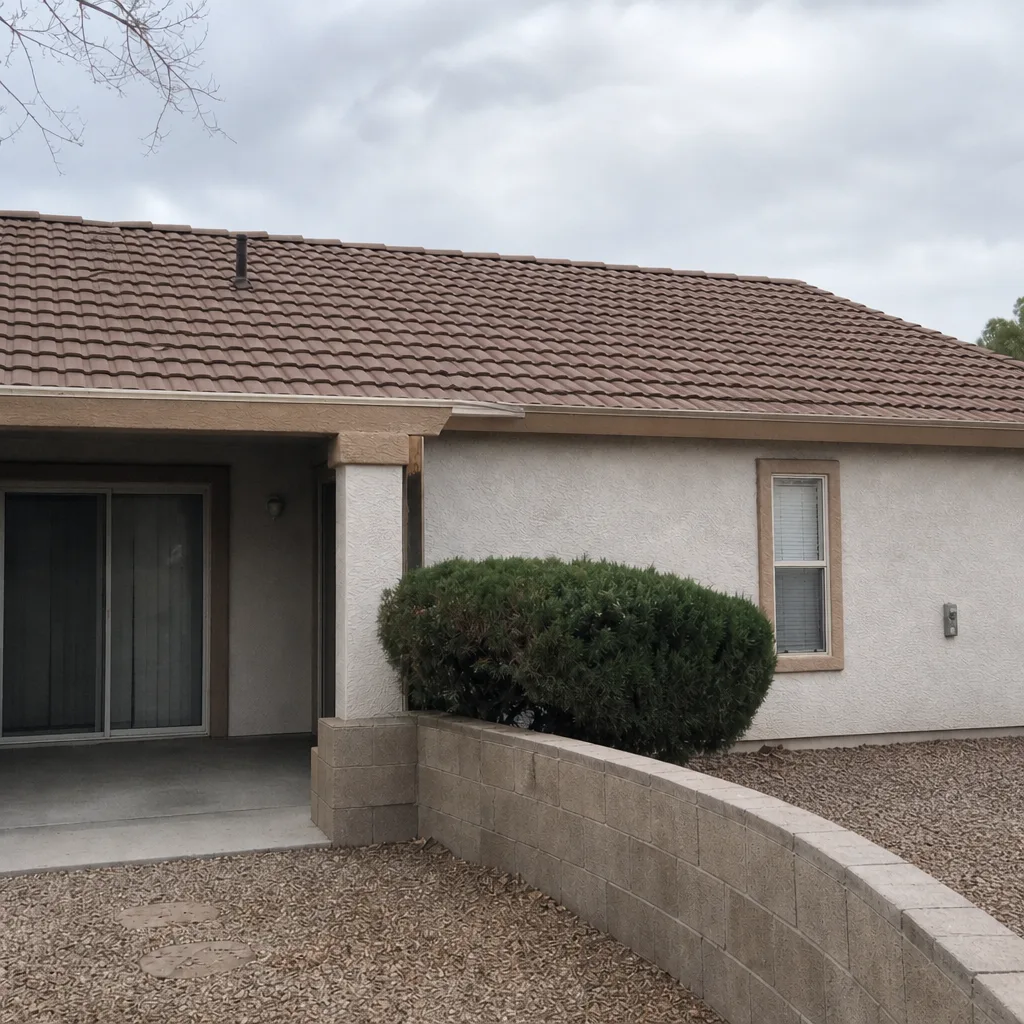 After
When to Call a Professional
Call a professional when you see any of these: a ceiling stain with a dark outer edge that’s growing, a soft or squishy spot in the ceiling, water pooling in the attic, a sag along the ridge, a roof under foot that feels spongy, multiple nails popping along a course, shingles shedding granules across every slope, or any leak that has returned to the same area more than once. Also call if a single check you ran came back inconclusive; a trained read is cheaper than guessing at replacement. Roofing Sunrise Manor offers free estimates in Sunrise Manor, and a standalone inspection tells you plainly whether you need a repair, a replacement, or neither. Call (888) 849-9122. We answer 24/7. Fast dispatch from 7am to 7pm, Sunday through Friday.
Frequently Asked Questions
Granule loss in gutters and downspouts is usually the first visible signal on a Sunrise Manor home, because shingle wear shows up there before any water gets inside. Read it alongside attic checks for daylight and deck staining, which catch problems before the exterior shows them.
No. The shape and color of a stain tell you more than the stain’s existence. A growing dark-outer-edge ring points to an active leak, a uniform brown patch often points to a historic one, and a lighter spread may be condensation. Get an inspection to identify the source before deciding on repair or replacement.
Sunrise Manor’s daily temperature swings between a sun-baked deck and cooler evenings drive repeated expansion and contraction across the roof. That movement backs nails out of their holes and lifts shingle edges over time. Isolation is a repair; a line of pops or widespread lifting means the deck under the roof should be checked.
A roofing inspection through us is quoted as its own service with a free estimate, and the written estimate sets the final price. Pricing is per job, and the inspection exists to tell you what your roof actually needs rather than to push a larger scope. Call (888) 849-9122 for an exact quote; estimates are free.
Most cities require a permit for a full roof replacement, so ask your city’s building department what applies to your address. We’ll tell you plainly whether we recommend a repair or a full replacement, and the scope of work in the written estimate makes clear what’s covered.
Matching is a real constraint on a repair, but it’s usually manageable because we install across GAF, CertainTeed, Owens Corning, IKO, Atlas, Tamko, and Boral. The brand and style on the roof determine the match, and working across all seven means we can usually find a product that fits without creating a visible scar or breaking out of a warranty coverage.
The Bottom Line
The warning signs that matter most on a Sunrise Manor roof are easy to walk past: granule loss in the gutters, nail pops and lifted shingle edges from thermal expansion, attic signs like daylight and deck staining, and ceiling stains whose shape and color tell you whether a leak is active, historic, or condensation. Small and isolated usually means repair. Widespread ageing, repeated leaks, or a compromised deck usually means replacement. An inspection makes the difference clear. If any of the signs in this guide turned up on your roof, call (888) 849-9122 for a free estimate in Sunrise Manor. We answer 24/7, with fast dispatch from 7am to 7pm, Sunday through Friday.
Written by the team at Roofing Sunrise Manor.